How to Get a Philippines Student Visa (2025 Guide for ESL Students)
Introduction
The Philippines has quickly become one of Asia’s top destinations for students looking to learn English in an immersive, affordable, and culturally rich environment. Every year, thousands of learners from Japan, Korea, Vietnam, Taiwan, the Middle East, and Europe travel to popular ESL hubs such as Cebu, Manila, and Baguio.
But before you can start studying, you need to understand the Philippines student visa system and how international students can legally stay and study in the country. Whether you’re planning a short-term ESL course or a longer academic program, knowing the right visa option is essential. That’s why many students searching for Philippines student visa information usually ask:
- Do I need a student visa to study English in the Philippines?
- What’s the difference between a Student Visa (9F) and an SSP?
- Can I study English on a tourist visa?
Understanding the Philippines Student Visa System
The Philippines has a unique Philippines student visa structure. Unlike Western countries, there are two ways to legally study:
1. Student Visa (9F Visa)
For university or long-term academic programs (degree courses).
2. Special Study Permit (SSP)
For short-term, non-degree courses — including all English language programs.
Important:
Most ESL students do not need a Student Visa (9F). They study legally using a Tourist Visa + SSP, which is the standard for all English schools in Cebu, Manila, and Baguio. to know more detail about Special Study Permit (SSP) visit this!
What Is a Student Visa (9F)?
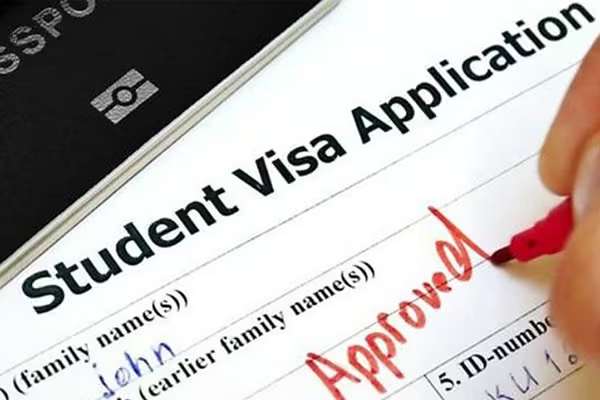
The 9F Student Visa is issued to foreign students entering formal degree programs in recognized Philippine universities.
Who Needs It?
- Students enrolling in Bachelor’s, Master’s, or Doctorate programs
- Long-term academic programs
- Those planning to stay for several years
Key Requirements
- Letter of Acceptance from a recognized university
- Completed application form
- Police Clearance from home country
- Medical exam authenticated by the Philippine Embassy
- Proof of financial capacity
- Passport valid 6+ months
- ID photos
Where to Apply?
At the Philippine Embassy in your home country — before entering the Philippines.
Note: This visa is not used by ESL schools.
What is an SSP (Special Study Permit)?
The SSP is the official permit required for studying:
- English language programs (ESL)
- Short-term courses
- Training programs
- Non-degree studies
All foreign ESL students need an SSP — even those on a visa-free entry.
Key Facts
- Valid for up to 6 months
- Can be renewed
- Issued by the Bureau of Immigration
- Your ESL school processes the application for you
Documents Needed
- Passport copy (bio + entry stamp)
- SSP application form (school provides)
- 2 photos
- School accreditation
- Payment receipt
Step-by-Step: How to Study English Legally in the Philippines
Step 1 — Choose an Accredited ESL School
Only accredited schools can apply for SSP.
Step 2 — Receive Your Letter of Acceptance (LOA)
You’ll need this to process your SSP or your visa extensions.
Step 3 — Enter the Philippines on a Tourist Visa
Most nationalities get 30 days visa-free (Japan, Korea, Turkey, EU, UAE, etc.)
Others must apply for a tourist visa at the Philippine Embassy.
Step 4 — School Processes Your SSP
You submit your documents → the school applies at the Bureau of Immigration.
Step 5 — Pay Required Fees
- SSP: PHP 6,000–7,000
- Visa Extension: PHP 3,000–4,000
Step 6 — Receive Your SSP
Processing time: 7–10 working days.
Visa Requirements by Country (Tourist Entry for ESL Students)
Below is a complete table showing entry rules for common student nationalities.
Note: All ESL students, regardless of nationality, MUST obtain an SSP after entering the Philippines.
Country / Region | Need Visa Before Arrival? | Visa-Free Stay | Can Extend in the Philippines? | SSP Required? | Notes |
Iran | Yes | None | Yes (1–2–6 month options) | Yes | Must apply at Philippine Embassy before travel |
Turkey | Yes | None | Yes | Yes | Same process as Iran; tourist visa required first |
Azerbaijan | Yes | None | Yes | Yes | Embassy application needed before arrival |
Saudi Arabia | Yes | None | Yes | Yes | Common for long-term ESL (8–24 weeks) |
UAE | No | 30 days | Yes | Yes | Easy entry + normal extensions |
Qatar | No | 30 days | Yes | Yes | No visa needed for arrival |
Japan | No | 30 days | Yes | Yes | Very simple process, extendable up to 36 months |
South Korea | No | 30 days | Yes | Yes | Koreans form the largest ESL student group |
Vietnam | No | 21–30 days | Yes | Yes | Extensions handled by school |
Thailand | No | 30 days | Yes | Yes | Standard ESL process |
Russia | No | 30 days | Yes | Yes | Visa-free for 30 days |
Kazakhstan | No | 30 days | Yes | Yes | Same as Russia |
EU Countries (Schengen) | No | 30 days | Yes | Yes | Only passport required |
UK | No | 30 days | Yes | Yes | Very easy arrival process |
USA | No | 30 days | Yes | Yes | SSP always required for ESL |
Canada | No | 30 days | Yes | Yes | Simple tourist entry |
Australia | No | 30 days | Yes | Yes | SSP + extensions required |
India | Yes | None | Yes | Yes | Needs tourist visa before arrival |
Nepal | Yes | None | Yes | Yes | Embassy processing required |
Pakistan | Yes | None | Yes | Yes | Tourist visa required before travel |
How Long Can Students Stay in the Philippines?
With extensions, you can stay up to:
36 months (3 years)
without leaving the country. This is one reason the Philippines is so popular among ESL learners.
Mistakes You MUST Avoid
- Studying English without an SSP
- Choosing a non-accredited school
- Overstaying your tourist visa
- Not checking your nationality’s entry rules
These mistakes cause fines, delays, or deportation.
Frequently Asked Questions
1. Do I need a 9F Student Visa for ESL?
No. ESL students study on SSP + Tourist Visa.
2. Can I work while studying?
No — neither SSP nor 9F allow employment.
3. Can I stay long-term?
Yes, up to 3 years with extensions.
4. How long does SSP processing take?
About 7–10 business days.
5. Can minors apply?
Yes — SSP is available for all ages.

Why Enroll Through Our Agency?
Studying legally in the Philippines requires the right school and correct paperwork — and we help you with both.
- We work only with accredited ESL schools
- We process your SSP and visa extensions
- We help you choose the best city (Cebu, Manila, Baguio)
- We support you from application to arrival
- 100% free consultation
Start your English-learning journey in the Philippines with Bridge of English — we guide you legally, safely, and stress-free from application to arrival. Contact us today!
Conclusion
Getting permission to study English in the Philippines is simple — if you understand the system clearly. Many students search for the Philippines student visa, but in reality, most ESL learners do not need a traditional student visa. They study legally with:
Tourist Visa + SSP (Special Study Permit)
Follow the requirements carefully, choose an accredited school, and make sure your documents stay updated at all times. With the right preparation — and the support of a reliable education agency — you can enjoy a safe, affordable, and inspiring study experience in one of Asia’s friendliest countries.